Clean Architecture: real benefits and common pitfalls
Four layers, twelve interfaces, and a Use Case that runs a single query. How Clean Architecture leaves the books and becomes overengineering — and when it actually pays off.
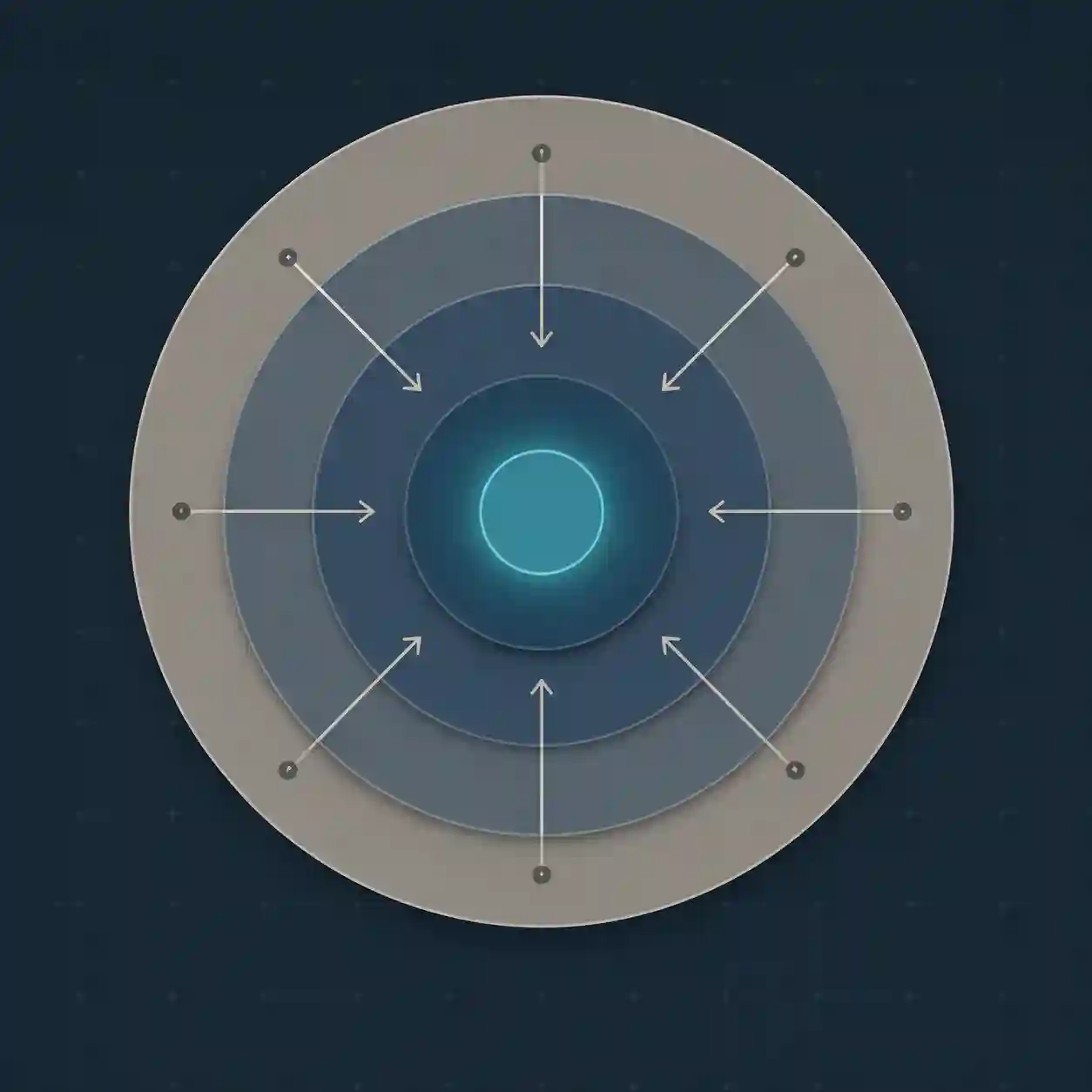
You decide to adopt Clean Architecture on the new project. Three weeks later, you have four layers, twelve interfaces, and a UseCase that runs a single database query. The code is "architecturally correct" and completely unreadable to anyone new on the team.
This isn't a failure of implementation. It's the most common pattern for how Clean Architecture moves from books to real projects.
What Clean Architecture actually says
Robert C. Martin introduced the concept in 2012 and consolidated it in his 2017 book. The central idea is straightforward: business rules should not depend on infrastructure details. Database, web framework, delivery mechanism — all of that is a detail. The core of the system is the logic that exists independently of how it's exposed or persisted.
The visual representation is concentric circles:
- Entities — enterprise business rules. Most stable, no external dependencies.
- Use Cases — application rules. Orchestrate flow between entities and interfaces.
- Interface Adapters — controllers, presenters, gateways. Translate data between inner and outer layers.
- Frameworks & Drivers — database, web framework, UI. Everything implementation-specific.
The Dependency Rule is the only real commandment: dependencies only point inward. Use Cases can depend on Entities, but never the reverse. Infrastructure can depend on Use Cases, but Use Cases never import anything from Infrastructure.
Entities ← Use Cases ← Interface Adapters ← Frameworks/Drivers
If you reversed any arrow in that diagram, you broke the architecture — regardless of how many nicely named folders you created.
The benefits, when they actually apply
Real testability
This is the most concrete benefit. When Use Cases depend on abstractions (interfaces) rather than concrete implementations, you test business logic without a running database, without HTTP, without a filesystem.
# Use case depends on the abstraction
class ProcessOrder:
    def __init__(self, repo: OrderRepository, notifier: Notifier):
        self.repo = repo
        self.notifier = notifier

    def execute(self, order_id: str) -> None:
        order = self.repo.find(order_id)
        order.confirm()
        self.repo.save(order)
        self.notifier.notify(order)

# In tests: inject doubles without infrastructure
order_repo = InMemoryOrderRepository()
notifier = FakeNotifier()
use_case = ProcessOrder(order_repo, notifier)
That test runs in milliseconds — no Docker, no database seeds, no brittle fixtures. In systems with complex business logic — financing calculations, compliance rules, dynamic pricing — this is the difference between real test coverage and test coverage that nobody runs locally because it takes six minutes.
Framework independence
The framework is a delivery detail. With the Dependency Rule in place, you can switch from Flask to FastAPI, from Express to Fastify, without touching business logic. In practice, full framework replacement is rare — but major version upgrades with breaking changes aren't. When the system core doesn't depend on the framework, migrations stay surgical.
Code longevity
Business systems evolve. Calculation rules change, new delivery channels appear, external integrations get replaced. When business rules are isolated, infrastructure changes don't cascade into the core — and vice versa.
If you've read the post on Clean Code without dogma, you've already seen that implicit coupling is one of the biggest sources of maintenance bugs. Clean Architecture resolves coupling at the architectural level — same idea, applied at larger scale.
The real pitfalls
Overengineering on small projects
This is the most common mistake. Clean Architecture has a setup cost: more files, more indirection, more abstractions to keep in your head. On a simple CRUD or an API with ten endpoints, that cost never amortizes.
An internal automation script, a webhook processing events, an admin tool — none of those cases justify four layers. They justify direct, well-named code with tests where there's non-trivial logic.
The right question before adopting: "will the business logic in this system grow and diversify over time?" If the answer is no, Clean Architecture is overengineering with a nice name.
The folder illusion
The most frequent mistake in codebases that "use Clean Architecture" is confusing folder structure with architecture.
src/
  domain/
    user.py
  use_cases/
    create_user.py
  infrastructure/
    user_repository.py
  controllers/
    user_controller.py
Having these folders guarantees nothing. If use_cases/create_user.py directly imports infrastructure/user_repository.py instead of depending on an abstraction, the Dependency Rule is broken — regardless of the directory structure.
Clean architecture isn't a filesystem layout. It's about the direction of dependencies at compile/runtime.
Anemic Use Cases
A common symptom of poorly applied Clean Architecture is Use Cases that do nothing except delegate:
class GetUserById:
    def __init__(self, repo: UserRepository):
        self.repo = repo

    def execute(self, user_id: str) -> User:
        return self.repo.find_by_id(user_id)  # pure delegation, no logic
This Use Case has no reason to exist. It's an indirection layer with no benefit — the controller could call the repository directly. Use Cases exist to orchestrate business logic, not to be nicely named wrappers around queries.
When you have dozens of Use Cases like this, the project gained all of Clean Architecture's complexity without any of its benefits.
Excessive data mapping
Clean Architecture often leads to DTOs at every layer boundary. That makes sense when formats genuinely diverge — what comes from the database isn't what goes to the client, and what comes from the client isn't what the domain processes. But when all objects have the same fields, you end up with five nearly identical classes and mapping code that's a guaranteed bug vector.
Practical rule: map at boundaries where the contract actually changes. Don't create mapping objects as a matter of principle.
When to actually use it
Clean Architecture pays off when two or more of these factors are present:
- Complex business logic — rules that change independently of infrastructure, that need fast unit tests, that exist beyond CRUD.
- Long-lived system — will be maintained and evolved for years, likely by different people.
- Multiple delivery interfaces — REST API, async workers, CLI, webhooks — all accessing the same business core.
- Team experience with the pattern — well-executed Clean Architecture requires the team to understand the why behind the rules. A team applying it for the first time will get the boundaries wrong and create coupling where they shouldn't.
If the project has only one of these factors, consider whether it's overengineering. If it has none, it is.
Clean Architecture in day-to-day work
In practice, reviewing whether the Dependency Rule is being respected is easier with a clear diff. When I'm evaluating whether a change crossed the wrong layer boundary — a Use Case directly importing an infrastructure class, for instance — I use the Code Diff Checker to see exactly what changed in the imports before approving.
Frequently asked questions
Is Clean Architecture the same as Hexagonal Architecture?
They're not identical, but they solve the same problem. Hexagonal (Ports and Adapters, by Alistair Cockburn) is simpler conceptually: you have an application core and adapters that implement "ports" (interfaces). Clean Architecture adds more layers and distincts between Entities and Use Cases. In practice, many projects use a hybrid. The central principle — business core without infrastructure dependency — is the same.
Can you migrate a legacy project to Clean Architecture?
Yes, but incrementally. You don't refactor an entire system at once without risk. The pragmatic approach: identify the modules with the most business logic and the most change, extract abstractions at those boundaries first. The rest of the system can stay as-is until the refactoring makes economic sense. Trying to apply Clean Architecture to an entire legacy codebase at once is a recipe for a stalled project.
Does Clean Architecture work with frameworks like Django or Rails?
It works, but requires discipline. Conventional MVC frameworks encourage putting logic in the model or controller. You can create a separate Use Cases layer and use the ORM as the repository implementation — but you'll be swimming against the framework's current. For small Django projects, it's probably not worth the friction. For large systems with real business logic, the separation pays off.
What's the difference between Clean Architecture and DDD?
They're complementary, not competing. DDD (Domain-Driven Design) is about how to model the domain — Aggregates, Entities, Value Objects, Bounded Contexts. Clean Architecture is about how to organize dependencies between layers. A system can use both: DDD to model the core and Clean Architecture to isolate that core from infrastructure.
Clean architecture is about dependencies, not folders
The only criterion that matters is the Dependency Rule. Every other decision — how many layers, how many interfaces, how to name the folders — follows from where the dependencies point.
A project with three files that respects the Dependency Rule has Clean Architecture. A project with forty folders and correct names where Use Cases import concrete repositories doesn't — it has the appearance without the substance.
Before adopting, ask the question that matters: does the system have enough business complexity to justify the cost of indirection? If yes, the investment pays off over time. If not, simple, direct, well-tested code is the right architecture for the problem you actually have.
- 01 UTF-8 and encoding problems: why accents break and how to fix them What UTF-8 is, code points, mojibake, and why accented text turns to garbage — the mechanism explained end to end.
- 02 MIT, Apache, and GPL Licenses: Practical Differences for Developers MIT, Apache 2.0, and GPL are not the same thing. Understand permissive vs copyleft, patent protection, and compatibility before shipping code to production.