Personal Projects That Help You Get a Job: Which Ones Count and How to Present Them
Which personal projects actually help you land a tech job, how many to keep in your portfolio, and how to present them to a recruiter.
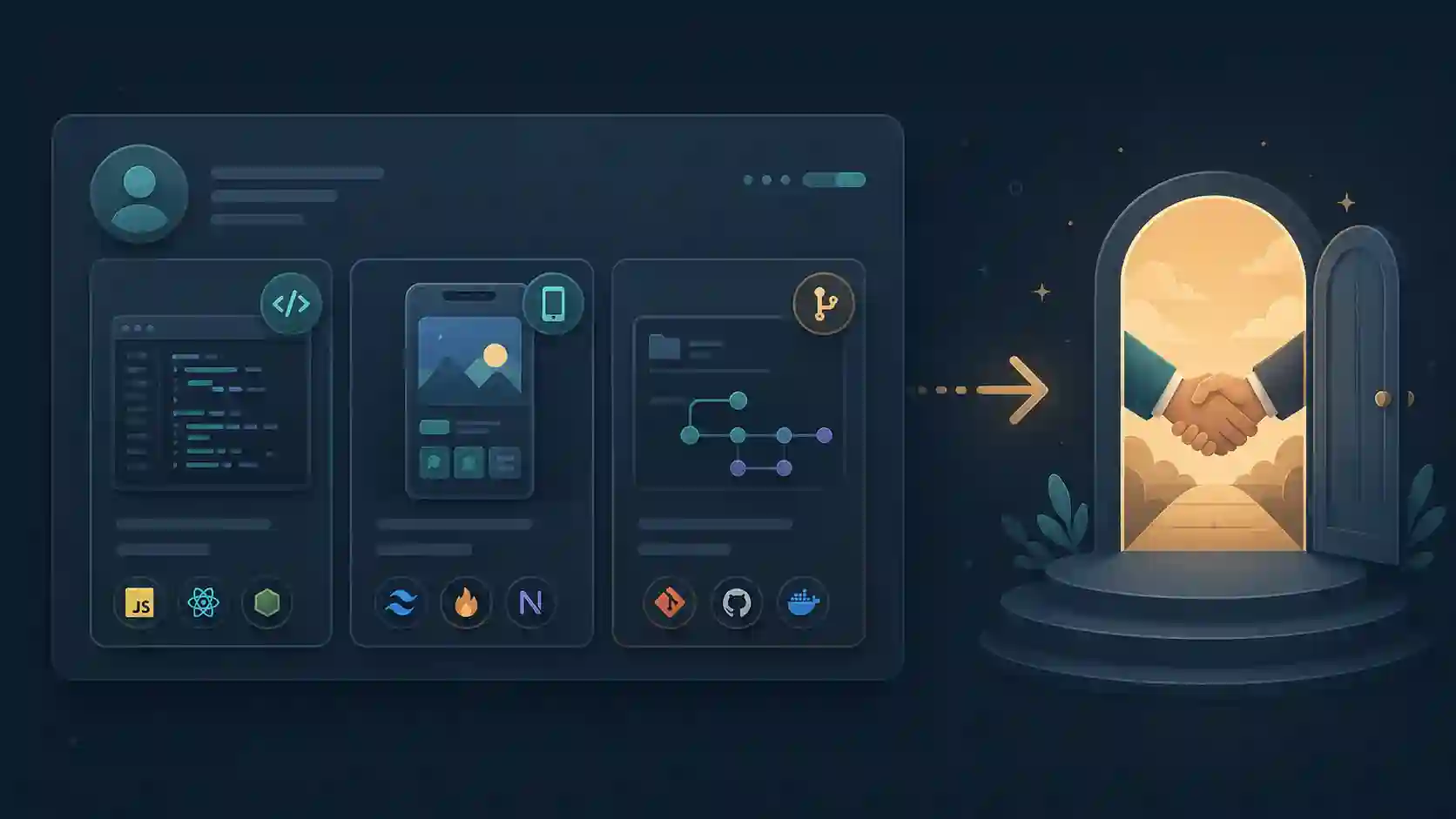
You finished the course, did the exercises, built a portfolio with three projects, and your applications still vanish into a black hole. The problem is rarely a lack of projects: it's that the projects you built look exactly like the ones thousands of other candidates submitted. A to-do list clone, a calculator, a portfolio page that mostly talks about the portfolio itself. A recruiter glances at it and can't extract a single useful signal about how you think. This guide is about the opposite of that: which personal projects actually move the needle in an interview, and — more importantly — how to present them so a busy person grasps your value in thirty seconds.
Why most personal projects help nothing at all
The uncomfortable truth is that a project, on its own, almost never lands the job. What wins a recruiter over is the evidence of reasoning a project carries. A pretty CRUD app doesn't tell anyone whether you can choose between two approaches, handle an ugly error case, or explain why you picked one library over another. And that's exactly what the person on the other side needs to evaluate.
That's why tutorial projects copied line by line are worth close to zero. Not because building them is bad — they're great for learning — but because they don't set you apart from anyone. When a hundred candidates submit the same Netflix clone from the same YouTube video, the project stops being a signal and becomes noise.
The turning point happens when the project contains a decision of yours. Something you chose, got wrong, redid, and can defend. That small bit of friction — "I tried it the X way, hit a performance problem, migrated to Y" — is what turns code into an interview conversation.
The project types recruiters actually notice
Not every personal project carries the same weight. In practice, some formats communicate initiative and seniority far better than others.
A project that solves a real problem of yours. The most underrated and the strongest. A script that organizes your downloads, a bot that pings you when a price drops, a spreadsheet that grew into an app. It works because the motivation is genuine: you can explain the problem, the solution, and why it matters without memorizing anything.
Open source contributions. It doesn't have to be a giant pull request. Fixing a bug, improving confusing docs, or adding a test to a library you use already shows you can read someone else's code — a skill 90% of juniors never train. Technical recruiters can read a commit history, and seeing your name in a known project's repo beats ten solo projects.
A clone with a decision of your own. Clones do count, as long as you add a layer of reasoning. Rebuilt a Twitter clone but implemented cursor-based pagination instead of offset? Compared Server-Sent Events with WebSocket for the real-time feed? That stops being a copy and becomes a case study.
A domain-specific project. If you want to break into fintech, a project dealing with interest calculation, reconciliation, or currency formatting says more than a generic portfolio. Aligning the project with the role's niche is a huge shortcut to looking like the right fit.
The right amount: quality over volume
One of the most common questions from people building a portfolio is how many projects to include. The consistent answer among recruiters is simple: 3 to 5 well-documented projects beat any list of fifteen half-finished repos. A portfolio with twenty unfinished projects signals the opposite of what you want — a lack of focus and trouble finishing things.
Favor depth. Three projects with a decent README, a working deploy, and a commit history that tells a story are worth infinitely more. In fact, a repo with a single giant commit named "first commit" is a quiet red flag: it suggests you only pushed the final result, with no process behind it.
If you're still in the phase of building technical fundamentals before jumping into projects, it's worth aligning that effort with a bigger plan — roughly what I lay out in the programming study roadmap, which is about the order in which to learn. Here the focus is the next step: turning what you learned into concrete proof.
How to present it: the README is your real résumé
Most juniors invest 95% of their time in the code and 5% in the presentation. Recruiters do the reverse: they open the README before the code. A strong README answers, in order, four questions:
- What it is and what problem it solves (one sentence, at the top).
- How to run it (ideally a
docker compose upor three commands). - Technical decisions — the section that wins the interview.
- What you'd do differently — shows self-criticism and seniority.
The technical decisions section is the most neglected and the most powerful. Something like this:
## Technical decisions

- **Cursor pagination instead of offset**: the feed grows fast and offset
  gets slow on big tables. Cursor keeps the query O(log n).
- **Chose SQLite for the MVP**: zero infra for the recruiter to run locally.
  In production I'd swap it for Postgres (see `docs/scaling.md`).
- **No state framework**: the app is small; Context API is enough.
  Redux would be over-engineering here.
Three bullets like these say more about your maturity than a thousand lines of nicely indented code. They prove you understand that every choice has a cost.
Another thing worth gold: keep the project running. A deploy link that opens instantly removes the friction. A recruiter won't clone the repo, install dependencies, and configure environment variables — they have forty more candidates in the queue. Vercel, Netlify, Render, and Railway have free tiers that solve this in minutes.
Mistakes that bury a good portfolio
Even solid projects die over presentation details. The most common ones:
- No deploy and no screenshot. If the recruiter can't see it working in ten seconds, they assume it doesn't work.
- Template README. That default
create-react-apptext still sitting in the repo screams "I didn't finish." - Committed credentials. An API key in your Git history is instant disqualification at any company that takes security seriously.
- No focus on the role's audience. Sending a portfolio full of games for a payments backend role scatters attention.
- Commits with no story. "fix", "update", "aaa", "asdf". The history is part of the product you're selling.
Frequently asked questions
How many projects do I need to land my first job? Three to five well-built ones. The focus is quality and clarity, not volume. A lean portfolio with a README, a deploy, and explained technical decisions easily outperforms a long list of half-finished repos.
Do bootcamp projects and clones of well-known apps count? They count, as long as you add something of your own. A clone copied from a video is worth little; the same clone with a technical decision of yours, a handled error case, or a feature the original lacks becomes a legitimate case study.
How do I present a personal project to a recruiter? Start with the README: what it solves, how to run it, which technical decisions you made, and what you'd do differently. Have a working deploy link and a commit history that shows the process. The code gets checked later — the presentation is what opens the door.
Is it better to contribute to open source or build a project from scratch? They signal different things. A project from scratch shows initiative and the ability to take something from start to finish; open source proves you read and respect other people's code and collaborate on an existing base. If you can, have one of each — it's the most convincing combo.
What to take from this guide
A personal project isn't proof that you can code; it's proof of how you think while coding. What separates a portfolio that opens doors from one that disappears into the pile isn't the number of lines — it's how clearly you expose your decisions. Pick 3 to 5 projects, give each one a README that defends its choices, keep everything running behind a link, and align at least one of them with the niche you're targeting. Do that and your portfolio stops being one more dead file and becomes the script for your next interview.
- 01 UTF-8 and encoding problems: why accents break and how to fix them What UTF-8 is, code points, mojibake, and why accented text turns to garbage — the mechanism explained end to end.
- 02 MIT, Apache, and GPL Licenses: Practical Differences for Developers MIT, Apache 2.0, and GPL are not the same thing. Understand permissive vs copyleft, patent protection, and compatibility before shipping code to production.